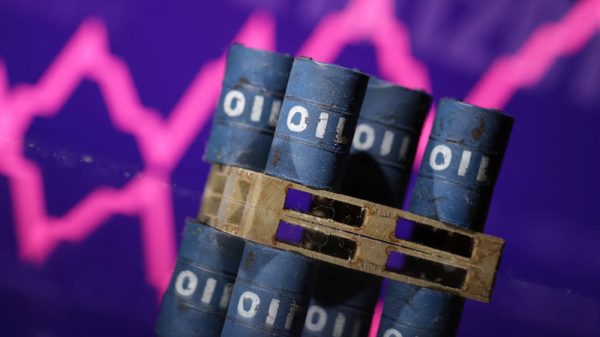


Gold retreated sharply on Monday as a perfect storm of geopolitical tension and inflation anxiety swept through commodity markets, erasing last week’s gains and dragging the precious metal to its lowest level in recent sessions.
The Selloff
Spot gold fell 2.2%, dropping below $4,700 per ounce, as investors moved away from the safe-haven metal in favor of the US dollar. Silver was hit even harder, sliding 3.1% to $73.52 per ounce. Equity futures also declined, while the dollar index climbed 0.4%, applying additional pressure on dollar-denominated commodities like gold.
The Hormuz Factor
The catalyst behind Monday’s turbulence traces directly to the Strait of Hormuz. After six weeks of war in the Middle East, weekend peace negotiations between Washington and Tehran collapsed without a permanent agreement, leaving a fragile ceasefire in further doubt.
President Donald Trump announced that the United States would impose a naval blockade on the strait effective 10:00 AM Eastern time, vowing to intercept any vessel that paid fees to Tehran in exchange for safe passage. Before the conflict, roughly one-fifth of the world’s crude oil and liquefied natural gas transited the narrow waterway connecting the Arabian Gulf to global markets. Oil prices surged 9% on the news, with energy analysts warning of a sustained supply shock if the blockade holds.
Why Higher Energy Prices Hurt Gold
The logic may seem counterintuitive — gold is traditionally viewed as an inflation hedge, so why is it falling as inflation risks rise?
The answer lies in interest rates. Soaring energy costs push inflation higher, which in turn makes it less likely that central banks will cut interest rates — or could even force them to raise rates further. Gold, which pays no yield, becomes less attractive when borrowing costs are elevated or climbing. Investors holding gold give up the opportunity to earn returns elsewhere, making the trade-off less appealing in a high-rate environment.
Monday’s dynamic illustrated this clearly: rising energy prices drove inflation concerns, strengthened the dollar, and pressured central bank expectations — a triple headwind for bullion.
US Inflation Already Running Hot
Monday’s selloff did not occur in a vacuum. Data released last Friday by the Bureau of Labor Statistics showed that US inflation accelerated in March at its fastest pace in four years, with gasoline prices responsible for nearly three-quarters of the increase — a direct echo of the conflict’s early economic impact. That reading reinforced fears that the Federal Reserve has little room to offer markets the rate relief that has historically supported gold prices.
The Bigger Picture
Gold’s retreat underscores a rare and uncomfortable situation for markets: a geopolitical shock that simultaneously raises inflation, strengthens the dollar, and reduces the likelihood of monetary easing. In most crises, at least one of those forces works in gold’s favor. Today, all three are working against it.
Whether this reversal proves temporary depends largely on how the Hormuz blockade develops in the days ahead. A prolonged disruption to energy flows would keep inflation elevated and the dollar firm — sustaining the pressure on gold. A diplomatic breakthrough, on the other hand, could quickly reverse the move, given how rapidly bullion erased a full week of gains in a single session.

 ↔
↔ 
 ↔
↔  ↔
↔  ↔
↔  ↔
↔  ↔
↔  ↔
↔  ↔
↔  ↔
↔  ↔
↔  →
→  →
→  →
→  →
→  →
→  →
→  →
→