

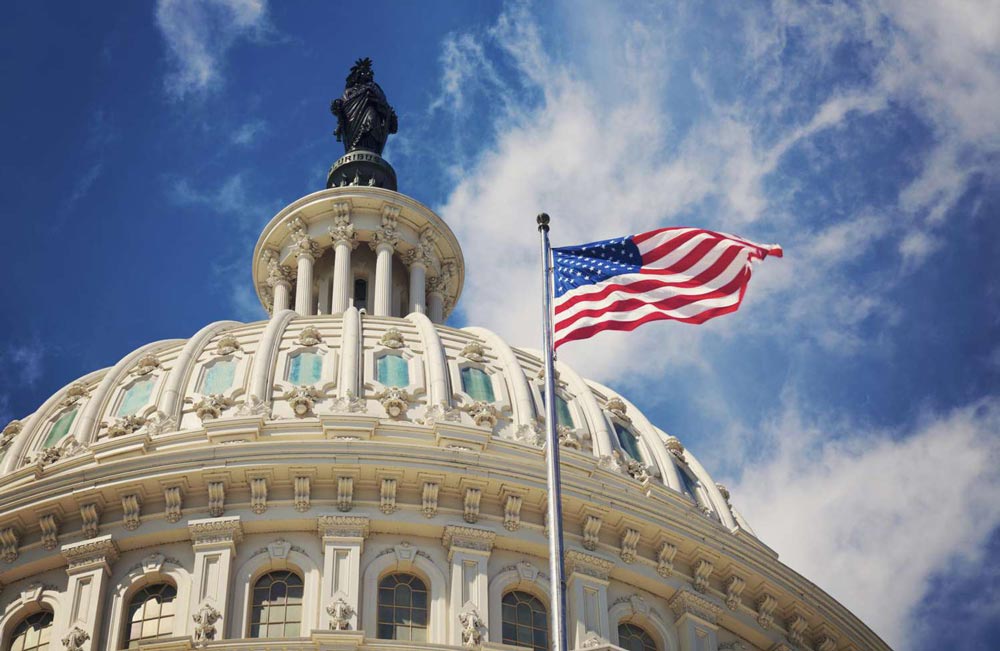
The United States is grappling with the longest government shutdown in its history, now stretching into its 39th day, with no resolution in sight. The impasse has created significant disruptions across multiple sectors, including air travel, healthcare, and economic policymaking, as the political tug-of-war between Democrats and Republicans intensifies.
Political Deadlock and Legislative Stalemate
Hopes for a swift resolution were briefly reignited when Congress convened to discuss potential solutions. However, optimism quickly dissipated as negotiations faltered. Despite their resounding victories in recent elections, Democrats scaled back their demands, proposing a one-year extension of tax credits under the Affordable Care Act in exchange for reopening the government.
The proposal was swiftly dismissed by Republicans, with some lawmakers labeling it as “dead on arrival.” Meanwhile, President Donald Trump insisted that lawmakers remain in Washington until they reach an agreement to resolve the spending crisis.
Impact on Economic Data and Federal Reserve Decisions
The shutdown has paralyzed critical government operations, including the release of key economic reports. The Bureau of Labor Statistics has been unable to publish its October Consumer Price Index (CPI) data, as field data collection was suspended. This delay in economic reporting has left the Federal Reserve in a precarious position as it prepares for its December meeting.
Without updated inflation and employment data, the Federal Reserve may struggle to decide whether to implement another interest rate cut. While September’s inflation rate showed a modest 3% year-on-year increase—lower than projections—policymakers are hesitant to act without more recent figures. Experts warn that even if the government reopens soon, processing the backlog of data could take weeks, forcing the Fed to rely on private-sector estimates and incomplete statistics.
Travel Disruptions Worsen Amid Staffing Shortages
The aviation industry has been one of the hardest-hit sectors during the shutdown. A shortage of air traffic controllers, many of whom have been placed on unpaid leave, has forced the Federal Aviation Administration (FAA) to reduce flight operations. Over the weekend, airlines were compelled to cancel hundreds of flights, with delays stretching for hours at major airports.
On Saturday alone, nearly 3.7% of the 21,748 scheduled flights were canceled, according to Cirium, an aviation analytics firm. The worst disruptions were reported at Newark Liberty International Airport, where average delays exceeded four hours. Other major hubs, including John F. Kennedy International Airport and San Francisco International Airport, also reported significant delays.
Transportation Secretary Sean Duffy announced a 10% reduction in flight operations to manage the crisis, warning that the cuts could increase to 15–20% if the staffing shortage worsens. With Thanksgiving—a peak travel season—approaching, the situation threatens to spiral further out of control.
Broader Economic and Social Fallout
The prolonged shutdown has exacerbated uncertainty for both businesses and households. Critical public services, such as healthcare programs, have been disrupted, leaving vulnerable populations without essential support. Additionally, labor market data for two consecutive months remain unpublished, further clouding the economic outlook.
Bloomberg Economics analysts predict that even if the government reopens soon, the delays in data collection and processing will hinder effective policymaking well into December. They also note that the lack of reliable inflation and employment metrics may prompt Federal Reserve officials to delay further rate cuts.
A Crisis of Confidence
As the shutdown drags on, its ripple effects underscore the growing polarization in American politics. The inability of lawmakers to reach a consensus on government funding has not only deepened the economic and social strain but also eroded public confidence in the government’s ability to function effectively.
With no clear end in sight, the U.S. economy is left bracing for further uncertainty, while millions of Americans face mounting challenges in their daily lives.

 ↔
↔ 
 ↔
↔  ↔
↔  ↔
↔  ↔
↔  ↔
↔  ↔
↔  ↔
↔  ↔
↔  ↔
↔  →
→  →
→  →
→  →
→  →
→  →
→  →
→