

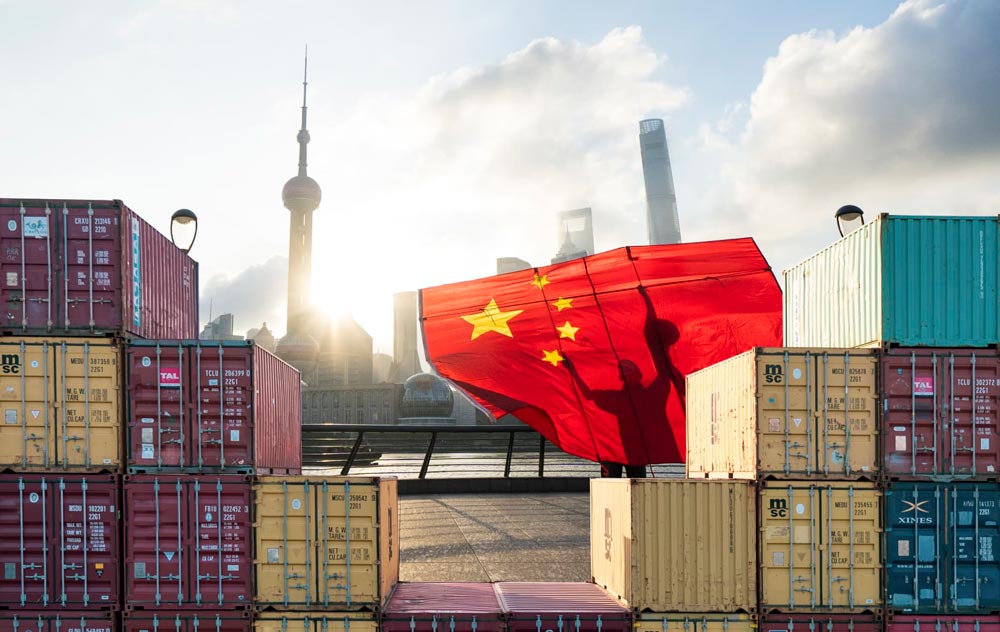
China’s trade surplus has reached a record-breaking $1 trillion, following a significant recovery in exports during November. This milestone highlights China’s resilience in global trade despite economic headwinds and geopolitical challenges.
Export Growth Surpasses Expectations
Chinese exports rose by 5.9% year-on-year in November, exceeding economists’ average forecast of 4%, according to a Bloomberg survey. Imports also grew by 1.9%, contributing to a trade surplus of $112 billion for the month. This recovery comes after an unexpected decline in exports in the previous month.
The record trade surplus coincides with easing tensions between China and the United States under President Donald Trump’s administration. However, analysts predict increased scrutiny from global trade partners, as cheaper Chinese goods continue to pressure local industries.
Mixed Export Performance
While China’s exports to the United States plummeted by 29%, marking the eighth consecutive month of double-digit declines, robust growth in shipments to the European Union, Latin America, and Africa offset these losses. Exports to the European Union surged by 15%, with France, Germany, and Italy experiencing double-digit growth. Meanwhile, exports to Africa jumped 28%, and shipments to Southeast Asia increased by 8.4%, albeit at a slower pace compared to previous months.
According to Lin Song, Chief Economist for Greater China at ING Bank, the recovery in exports to the European Union and Japan was “somewhat surprising.” She noted that November’s export data was stronger than anticipated, despite continued weakness in shipments to the U.S.
Adapting to the Trade Landscape
Despite the U.S.-China trade war, which escalated earlier in 2025, Chinese exporters have demonstrated remarkable adaptability. The world’s second-largest economy has diversified its export markets, focusing on regions beyond the U.S., such as Europe, Africa, and Southeast Asia.
David Qu, an analyst at Bloomberg Economics, highlighted the competitiveness and resilience of Chinese exporters. However, he warned that exports—once a key driver of China’s economic growth—now face persistent uncertainties and could gradually contribute less to the economy in the future.
Economic Implications
Exports have remained a critical pillar of China’s economic growth, compensating for sluggish domestic consumption and a prolonged housing market slump. However, challenges such as weak domestic demand and reduced reliance on imports by innovative Chinese companies have disrupted the trade balance.
The historic trade surplus is expected to bolster China’s GDP growth after months of economic slowdown. Although retail sales have declined and investment has contracted at record rates, the strong performance in early 2025 makes achieving the official growth target of 5% likely.
As China navigates these challenges, its ability to maintain trade momentum while addressing internal economic weaknesses will be crucial for long-term stability.

 ↔
↔ 
 ↔
↔  ↔
↔  ↔
↔  ↔
↔  ↔
↔  ↔
↔  ↔
↔  ↔
↔  ↔
↔  →
→  →
→  →
→  →
→  →
→  →
→  →
→