

As tensions rise in the Taiwan Strait, the island has emerged as a critical focal point for global economic stability and geopolitical power struggles. Taiwan, the world’s leading producer of advanced semiconductors, is at the center of a potential conflict between China and the United States. While the threat of war is not imminent, any future conflict could have catastrophic consequences for the global economy. According to a report by Bloomberg Economics, a U.S.-China war over Taiwan could cost the global economy up to $10.6 trillion in its first year alone, equivalent to 9.6% of global GDP — a fallout far worse than the 2008 financial crisis or the COVID-19 pandemic.
Taiwan’s Strategic Importance
Taiwan produces 62% of the world’s advanced semiconductors, a key component in products ranging from smartphones and cars to AI-powered data centers. The island is home to Taiwan Semiconductor Manufacturing Company (TSMC), which controls 70% of global semiconductor foundry revenues and supplies major tech giants like Apple, Nvidia, and Qualcomm. Any disruption in Taiwan’s semiconductor production would send shockwaves through global supply chains, crippling industries reliant on these chips.
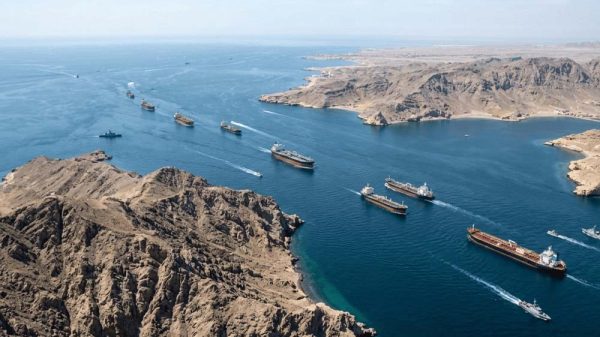
Taiwan’s geographical position also makes it a vital trade corridor. The Taiwan Strait sees nearly half of the world’s container ships and over 20% of global maritime trade, valued at $2.45 trillion annually.
Additionally, Taiwan serves as a symbol of democracy in Asia and a test of U.S. credibility in the region. For Beijing, the island represents a non-negotiable part of its territorial sovereignty. For Washington and its allies, defending Taiwan underscores their commitment to countering authoritarian influence in the Indo-Pacific.
Five Possible Scenarios
The Bloomberg Economics report outlines five potential outcomes for the escalating tensions between China and the United States over Taiwan:
All-Out War
A full-scale Chinese invasion of Taiwan would be the most devastating scenario. Such a conflict could severely disrupt global semiconductor supplies, halt trade in the region, and lead to a complete breakdown of U.S.-China economic ties. Taiwan’s economy could shrink by 40%, while China’s GDP would decline by 11%, and the U.S. economy would shrink by 6.6%. Globally, GDP could drop by 9.6%.
Chinese Naval Blockade
Beijing could impose a naval and aerial blockade around Taiwan, cutting off trade and essential supplies. This move would lead to significant disruptions in global semiconductor production and trade. Taiwan’s GDP could decline by 12.5%, while the global economy could shrink by 5.3%.
Gradual Escalation
China might adopt a strategy of incremental pressure, employing economic sanctions, cyberattacks, and increased military presence in the Taiwan Strait. While less catastrophic than war or a blockade, this scenario would still destabilize global trade and markets, causing a modest 0.6% decline in China’s GDP and a 0.2% drop in global GDP.
Maintaining the Status Quo
Despite rising tensions, the current balance could persist, with Taiwan continuing its de facto independence and China refraining from military action. This scenario would avoid immediate economic shocks but does not eliminate the long-term risk of conflict.
Peaceful Resolution
The least likely scenario involves a diplomatic settlement between China and Taiwan, potentially leading to expanded cross-Strait trade and reduced tensions between Washington and Beijing. This outcome would result in economic benefits for all parties but faces significant political and ideological barriers.
The Military Dimension
The U.S. no longer holds a decisive military advantage over China in the Taiwan Strait. China has developed advanced capabilities, including hypersonic missiles, stealth aircraft, and anti-ship ballistic missiles, often referred to as “carrier killers.” These advancements have shifted the balance of power, making any U.S. intervention in a Taiwan conflict riskier and less assured of success.
Moreover, China’s proximity to Taiwan gives it a logistical advantage. U.S. forces would face extended supply lines and significant operational challenges if they sought to defend the island. China’s military modernization, combined with its largest navy in the world, underscores its growing ability to challenge U.S. dominance in the region.
Economic Fallout
A conflict over Taiwan would have profound economic consequences:
Semiconductor Supply Disruptions: Taiwan’s semiconductor production would come to a halt, leading to a global shortage of chips. Industries such as automotive, electronics, and AI would suffer severe setbacks.
Trade and Shipping: A war or blockade would disrupt shipping routes, particularly in East Asia, with ripple effects on global trade.
Global Markets: Financial markets would experience extreme volatility. Companies heavily reliant on Taiwan’s semiconductors, such as Apple and Nvidia, would face supply chain paralysis.
Regional Economies: East Asian economies, including South Korea and Japan, would bear the brunt of the economic fallout, with GDP declines of up to 23% and 14.7%, respectively.

 ↔
↔ 
 ↔
↔  ↔
↔  ↔
↔  ↔
↔  ↔
↔  ↔
↔  ↔
↔  ↔
↔  ↔
↔  →
→  →
→  →
→  →
→  →
→  →
→  →
→