

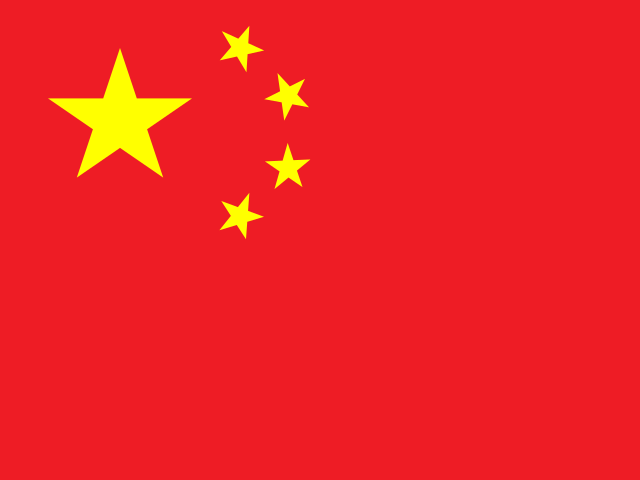
China has increased the maximum quotas for institutional investment in foreign securities by the largest margin since 2021. This move aims to further open up the financial sector and meet the growing domestic demand for overseas investment.
According to data from the State Administration of Foreign Exchange (SAFE) released last Friday, quotas under the Qualified Domestic Institutional Investor (QDII) program rose to $176.17 billion by the end of March, compared to $170.87 billion a month earlier. The $5.3 billion increase, the first since last June, represents the largest rise since 2021, as reported by Bloomberg.
Stability of the Yuan Encourages Capital Flexibility
The QDII program allows eligible domestic institutions to purchase foreign assets within specified limits. China’s relative stability in both the yuan and its local financial markets, even in the face of geopolitical uncertainties like the ongoing conflict in Iran, provides Beijing with the flexibility to ease capital controls and expand the yuan’s global role.
Becky Liu, Head of China Macro Strategy at Standard Chartered Bank, stated that the move was largely anticipated as China has been planning for a long time to relax capital account restrictions and offer greater flexibility for cross-border investments. While the increase was expected, the timing and the magnitude have drawn significant attention, with China significantly raising quotas during a period of global market uncertainty. This increase signals that China has not faced major pressures from capital outflows since the beginning of regional conflicts, and may have even seen capital inflows.
Diversifying China’s Investment Portfolios
This development comes as the head of China’s currency regulator, Zhu Heixin, previously signaled the plan. Zhu highlighted that the increase in QDII quotas was designed to better serve domestic institutions’ needs for cross-border investment.
In recent years, Chinese institutional investors under the QDII program have shown strong demand for global assets, such as gold and U.S. and Japanese equities. This push for diversification reflects ample domestic liquidity and lower domestic returns, which drive the need to explore better opportunities abroad.
Between 2021 and 2025, assets under management in the program grew by 54%, reaching ¥939 billion (approximately $136 billion). However, quotas have often lagged behind the market’s appetite for foreign investments, with some fund managers even exhausting their allocated limits, according to a Bloomberg Intelligence study.
Yuan’s Response and Confidence in Governance
The Chinese yuan showed little reaction to the latest adjustment, slipping just 0.1% against the dollar on Monday to 6.9182. Although the yuan lost 0.8% in value against the dollar this month, it continues to outperform other major global currencies.
Xiaojia Zhi, a Chinese economy specialist at Crédit Agricole, noted, “We believe these changes reflect the authorities’ intention to encourage two-way capital flows and reveal growing confidence among regulators in maintaining yuan stability.”

 ↔
↔ 
 ↔
↔  ↔
↔  ↔
↔  ↔
↔  ↔
↔  ↔
↔  ↔
↔  ↔
↔  ↔
↔  →
→  →
→  →
→  →
→  →
→  →
→  →
→