
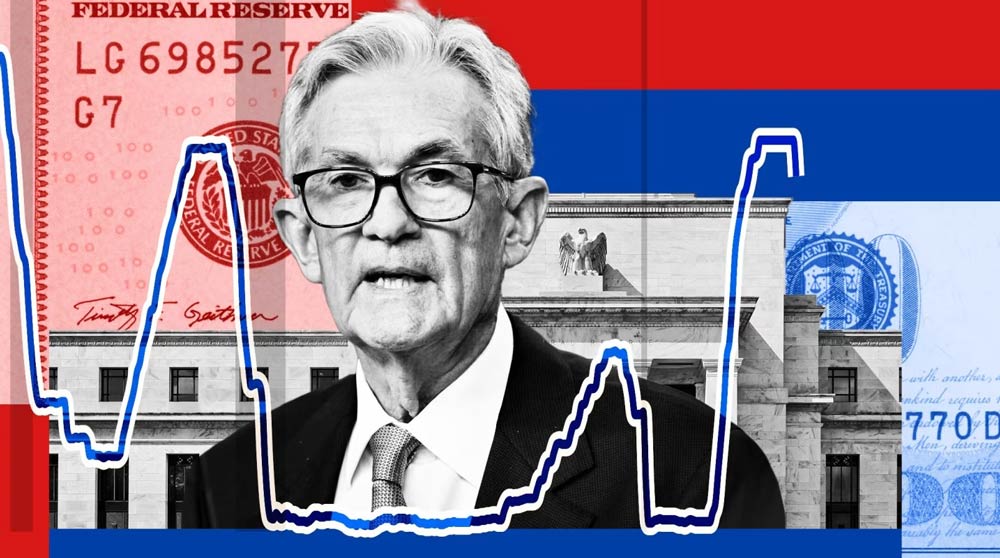
In a widely anticipated move, the Federal Reserve reduced its benchmark interest rate by 25 basis points to 3.75%, marking the lowest level since October 2022. This decision, announced during Wednesday’s policy meeting, aligns with expectations and reflects the ongoing shift toward a more balanced monetary policy approach amid easing inflationary pressures.
This marks the third rate cut in 2025 and the sixth since the central bank began its monetary easing policy in September 2024. At that time, interest rates were at a 20-year high of 5.5%. The cumulative reduction of 175 basis points over the past 15 months underscores the central bank’s efforts to support economic stability while navigating a challenging macroeconomic environment.
Reasons Behind the Rate Cut
The Federal Reserve’s decision comes amid a slowdown in inflation throughout 2024 and 2025, coupled with improving price stability indicators. These factors have provided the central bank with room to transition from a tightening monetary policy to a more accommodative stance. The Fed emphasized its commitment to monitoring economic data, particularly inflation, labor market conditions, and consumer spending, before making further policy adjustments.
Analysts suggest that the rate cut aims to promote economic growth by reducing borrowing costs for individuals and businesses, thereby encouraging investment and improving liquidity. However, the Fed remains cautious about external risks, including geopolitical uncertainties and fluctuations in energy and food prices, which could influence inflation trends going forward.
Balancing Growth and Inflation Targets
The Federal Reserve’s current strategy reflects its confidence in stabilizing prices while maintaining economic growth. By focusing on balanced monetary policies, the central bank seeks to achieve its dual mandate of price stability and full employment. However, further rate reductions will depend on continued improvements in key economic indicators.
Impact on Global and Regional Markets
The Fed’s decision has significant implications for global markets, particularly emerging economies that are sensitive to U.S. monetary policy changes. Lower interest rates often lead to increased capital flows into riskier markets, influencing exchange rates and investment patterns worldwide.
In response to the Fed’s move, central banks in Gulf Cooperation Council (GCC) countries announced similar rate cuts to maintain monetary stability. For instance:
- The Saudi Central Bank reduced its repo rate to 4.25% and reverse repo rate to 3.75%.
- The UAE Central Bank lowered its overnight deposit rate to 3.65%.
- Bahrain’s Central Bank cut its overnight deposit rate to 4.25%.
- Qatar reduced its deposit rate to 3.85% and lending rate to 4.35%.
- Kuwait’s Central Bank lowered its discount rate to 3.50%.
These adjustments reflect the Gulf countries’ commitment to aligning their monetary policies with global trends to support local economies amid ongoing economic challenges.

 ↔
↔ 
 ↔
↔  ↔
↔  ↔
↔  ↔
↔  ↔
↔  ↔
↔  ↔
↔  ↔
↔  ↔
↔  →
→  →
→  →
→  →
→  →
→  →
→  →
→